Your Excellency, President Bola Ahmed Tinubu, GCFR.
My Lord the Chief Justice of Nigeria. The Honourable Attorney-General of the Federation. My Lords. Learned Senior Advocates.
Distinguished ladies and gentlemen.
And, the reason we are gathered here: Chief Wole Olanipekun, SAN, CFR, who yesterday turned seventy-five, and who has been a pillar of the Nigerian bar for fifty of those years.
Sir, happy birthday.
Fifty years of practice, which are today celebrated with six volumes of cases.
Our Senior Advocate of Nigeria is a patriot, a pillar of our nation, and a titan of the law.
I should begin with a confession. I am not a lawyer – I am sometimes a client.
I have spent forty years growing businesses, closing deals, building institutions with men such as Chief Olanipekun, and I can tell you it is far more comfortable when he is on your side!
ON WOLE OLANIPEKUN
This keynote is on the rule of law as a catalyst for private sector growth.
I cannot think of a better forum to discuss it, because the man we honour today is the rule of law in human form.
And now a bit of history.
Called to the Bar in 1976. SAN in 1991, before his fortieth birthday. Attorney-General of the old Ondo State. President of the Nigerian Bar Association. Chairman of the Body of Benchers. Pro-Chancellor of the University of Ibadan, of Ajayi Crowther, and today of his own alma mater, the University of Lagos.
Lead counsel to four successive Presidents of this Republic, when their mandates were challenged in court.
Let me just focus on this, given we are in Presidential presence.
Four Presidents of different parties and, may I say, different temperaments, all chose the same man in the most consequential litigation of their careers.
This is not every day; this is not politics.
This is history and this is trust – and a demonstration of competence and capability.
And trust, as every banker – or retired banker – knows, is the only asset that cannot be bought. It can only be earned, slowly, and lost in an afternoon. Chief Olanipekun has spent fifty years earning trust and has never once lost it.
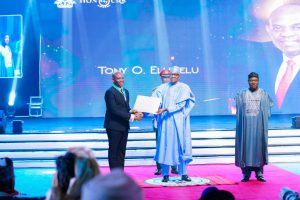
The six volumes the President of the Federal Republic of Nigeria will unveil today are called Wole Olanipekun Through the Cases.
I would humbly suggest a second title: Nigeria Through the Cases.
Because when historians want to know how this country argued with itself about power, property, elections and liberty over half a century, they will read these books.
Sir, you have taught us that a country’s institutions are only as strong as the people who serve them.
You have shown that in the courtroom, at the Bar, in our universities, and at home in Ikere-Ekiti.
Sir, we are in your debt.
THE RULE OF LAW, FROM A PRIVATE SECTOR LEADER
Now let me speak to the topic as an investor and entrepreneur, because I know there are enough lawyers in this room to cover the legal matters.
Here is what the rule of law means from an entrepreneur’s perspective.
To an entrepreneur, the rule of law means three simple things:
The contract I sign on Monday is still the contract on Friday.
The rule that binds me also binds my competitor.
When the government changes, the contract doesn’t.
Each of these is a precondition for capital.
Where any of them is in doubt, capital doesn’t argue. It leaves.
I have said it in New York, London, Paris and I’ll say it in Abuja: capital goes where it’s safe and stays where it’s respected.
Before power, before roads, before tax incentives, the first condition is a court judgment that is fair, impartial and timely.
We know that justice delayed is justice denied.
When my colleagues and I bought a struggling bank in 1997, the transaction rested on the belief that Nigerian law would protect a Nigerian buyer.
When we invested in Transcorp, in power, in oil and gas, each time we were making a judgement call on the Nigerian courts as well as on the Nigerian economy.
Looking forward, I want the next generation of Nigerian entrepreneurs to be able to enjoy those same fundamental protections. To be able to make the same bet with confidence.
That is what the rule of law, properly working, delivers: justice that is routine, not heroic and justice that is not delayed.
Efficient, fair and swift processes are a critical part of the enabling environment that is the contract between government and private sector.
ON THE PRESIDENT AND THE REFORMS
Which brings me, Your Excellency, to you Sir.
I have been in business in this country for some little while, under many governments.
This administration, inherited an economy that was in difficulty:
A fuel subsidy that consumed more than we spent on health and education combined.
Multiple exchange rates that rewarded arbitrage over enterprise.
A tax system that punished the compliant and ignored the rest.
Mr President, you took brave decisions:
Removed the subsidy.
Unified the exchange rate.
Signed the tax reform laws. At times you faced opposition.
I know the cost has been borne by ordinary Nigerians, and I know you know it too. But I also know, as an entrepreneur, that an economy cannot be rebuilt on a foundation of unreality, and you ended that unreality.
And there is a deeper connection to today’s theme.
Those reforms were themselves demonstrations of the rule of law.
Subsidies that are allocated by discretion,
Exchange rates that are allocated without transparency,
Taxes that are collected by negotiation
These are the enemies of the rule of law and the enemy of economic growth, a flourishing private sector, which in the spirit of Africapitalism, delivers for all.
A power sector that operates transparently, is a power sector that becomes investable, an investable power sector will light homes, power factories, create growth and support hospitals, schools and universities. Rules that apply to everyone is the rule of law in economic form.
But justice is still being delayed.
Justice is still being denied.
That is the reform the private sector has been waiting for, and it is the reform that will outlast all of us. Let us harness your reforming spirit, marry it with technology and the intellect of our legal profession. Let us set KPIs for case management and settlement. We can be effective and efficient.
Your Excellency, the private sector’s ask of you is now simple. Continue the boldness. A positive track record is being created, investor confidence is growing, capital is flowing – a giant is awakening.
Keep the focus on power.
CLOSE
On Monday, at the Europe–Africa Strategic Dialogue in Tuscany, we were told that “Africa has the resources; Europe has the capital, technology and markets.”
That was true in 1960. It was true in 1890. Africa is still waiting to benefit.
So, I told our friends: Africa will not be Europe’s raw-material diversification strategy. We will be an equal partner and a creator of value.
That’s Africapitalism: the private sector leading Africa’s development. A philosophy I espouse and practice.
But no private sector can do it alone. It can only do it under the law. Justice and prosperity are inseparable.
Chief Olanipekun has given us fifty years of the law.
Mr President, you are giving us the rules.
The rest of us must now build.
Chief, happy birthday. May there be many more volumes.
Thank you.
TOE